
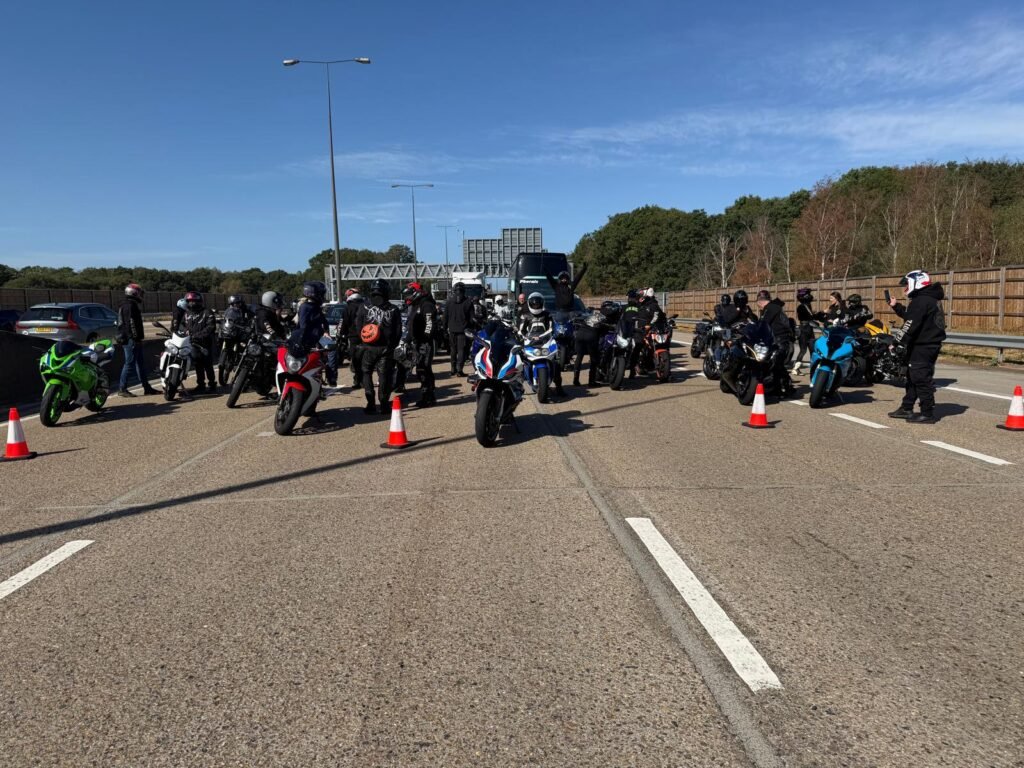
The first rideout is the one everyone’s nervous about. Will I keep up? Will I get lost? Will I hold everyone up? The honest answer is no, because a well-run group ride is built so nobody has to keep up. Here’s how it works.
Before you turn up
- Full tank, empty bladder. Fuel stops are planned around the bike with the smallest range, but arrive full anyway.
- Do your checks. Tyres, chain, lights, brakes. Five minutes at home saves the whole group waiting at the roadside.
- Full kit. Helmet, gloves, jacket, trousers, boots, every time. New to all this? Start with our guide to the non-negotiables.
- Phone charged, ICE contact saved. Put an emergency contact on your lock screen.
- Arrive early. The briefing happens before we roll, and you need to hear it.
The briefing
Before every ride, the leader runs through the route, the stops and who’s doing what. You’ll be told who the Ride Leader is and who the Tail-End Charlie is. They’re the only two riders who keep their position for the whole ride. Ask questions here, not at the first junction.
How the drop-off system works
This is how big groups stay together without anyone needing to know the route.
- The Ride Leader stays at the front and navigates. They never wait at junctions.
- When the route turns off the obvious road, the rider directly behind the leader pulls over somewhere safe and visible. They become the marker and point the way.
- Everyone else rides past the marker and follows the direction shown.
- The marker waits until Tail-End Charlie appears, then rejoins the group just in front of them.
- The next rider behind the leader becomes the next marker. Over the ride, everyone takes a turn and works their way back to the front.
The big win is that you never have to chase the bike in front. If you fall behind, there’ll be a marker waiting to show you the way. Ride your own ride.
Rules of the road
- Never overtake Tail-End Charlie. If you want to leave the group, pull in somewhere safe and wave the others past. Tell Tail-End Charlie when they reach you.
- Stagger on straight roads, single file through bends. Keep a two-second gap to the bike directly ahead.
- The Highway Code still applies. Red lights, speed limits, junctions. Being in a group doesn’t change any of it.
- No showing off. Wheelies and racing put the whole group at risk, and the group’s reputation goes with it.
- Stopping safely. If you’re marking, stop where you’re seen and legal, never on a roundabout or in a live lane.
Hand signals worth knowing
| Signal | Meaning |
| Arm pointing | Direction of travel (used by markers) |
| Pointing at the fuel tank | Need fuel |
| Hand patting the top of the helmet | Follow me, or I’m leading |
| Palm down, waving towards the road | Slow down |
| Pointing at the road surface | Hazard ahead, such as gravel, a pothole or oil |
The briefing will confirm which signals the group uses on the day.
After the ride
The best part of any rideout is the stop at the end: food, a brew, and talking through the ride. It’s the best place to meet the crew, ask questions and pick up tips from riders with years of experience.
Ride with us
Every rider was on their first rideout once. DEM BOYZ welcomes all levels, from fresh CBT to full licence. Join the crew, tell us what you ride, and we’ll let you know about the next one.
Sources: Phoenix Motorcycle Training, the drop-off system · West Wilts VMCC, group riding guidelines